(This is a brief introduction to Vygotsky’s theory – wider reading links and references are provided at the end of this summary).
Vygotsky’s work, from the start of the 20th century, theorised that social contexts could affect children’s learning. He suggested that, initially, cultural tools (such as speech) were used by children to help them negotiate and function socially and that it was the internalisation of these tools that allowed children to access higher level thinking skills and develop cognitively.
The Zone of Proximal Development
Vygotsky designed a model to chart the gap between a task that a learner was able to complete independently and one they were unable to complete. It was the gap between these two states, that he termed the Zone of Proximal Development (ZPD). In order to cross this gap, he proposed that learners use the help of a More Knowledgeable Other (such as a more knowledgeable peer, or teacher) to help them progress to being able to complete the task on their own. Vygotsky believed that learning occurred when students moved through the ZPD.
Vygotsky’s Zone of Proximal Development Model
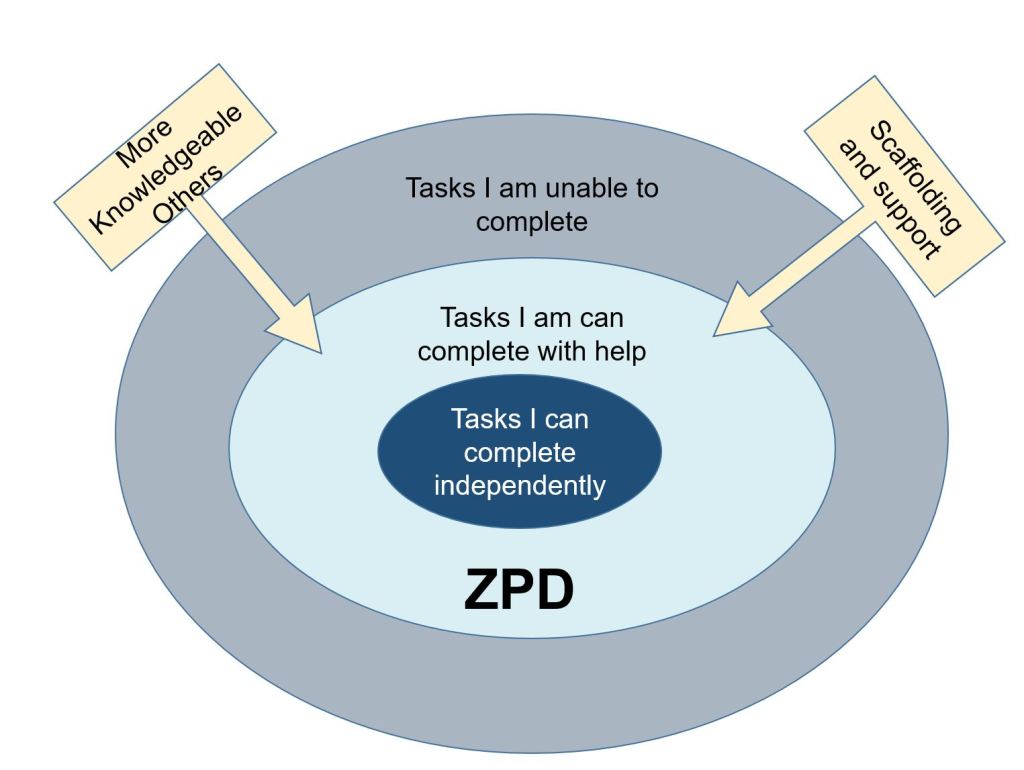
ZPD and scaffolding / modelling
Placing students in the ZPD should create enough level of challenge to develop their skills and understanding, but not so much that they are unable to complete the task. To help learners through this zone, More Knowledgeable Others (MKO) can use “scaffold” or model work to help them complete a task. Physical examples of scaffolding resources could include the use of writing frames, sentence stems, multiplication grids and exemplars.
To adopt a more metacognitive approach the MKO could also use live modelled examples, while explaining to learners how to plan, monitor, and evaluate their work throughout the completion of the task. However, it is vital that this scaffolding is used strategically and temporarily, so that students are ultimately able to complete the task independently and then move on to a higher level of learning. The EEF’sGuidance Report on Metacognition and Self-Regulated Learning recommends: 1) teachers live-model their thinking and 2) set appropriate levels of challenge as two of the strategies they could use to develop metacognition in the classroom.
References:
Quigley, A., Muijs, D., & Stringer, E. (2018). Metacognition and self-regulated learning: guidance report.
Vygotsky, L. S. (1980). Mind in society: The development of higher psychological processes: Harvard university press.
Wider reading:
Zone of Proximal Development and Scaffolding | Simply Psychology
 Metacognitively